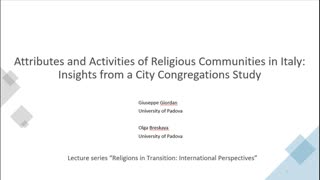
Attributes and Activities of Religious Communities in Italy: Insights from a City Congregations Study - Associate Professor Olga Breskaya - Universität Hamburg
- Lecture2Go
- Videokatalog
- F.5 - Geisteswissenschaften
- Religionen
- Religions in Transition: International Perspectives
Videokatalog
94 Aufrufe
20.04.2026
Attributes and Activities of Religious Communities in Italy: Insights from a City Congregations Study
This presentation explores the characteristics and activities of religious communities in three Italian cities using the City Congregations Study methodology. The research was conducted between 2020 and 2021, mapping a total of 877 communities in Bologna, Milan, and Brescia and their surrounding areas. The findings highlight key differences across traditions, with Catholic groups more involved in social services and Muslim and Orthodox communities more focused on supporting migrants. The study also reflects on patterns of urban religious diversity and their broader implications.
Olga Breskaya, PhD, is Associate Professor at the Department of Philosophy, Sociology, Education and Applied Psychology at the University of Padua, Italy. Her main research interests include the sociology of human rights, religious change in post-communist societies and religious socialization, religious pluralism, and the comparative study of religious freedom. She recently co-edited Religion Between Governance and Freedoms with Roger Finke and Giuseppe Giordan (Springer, 2024) and co-authored A Sociology of Religious Freedom with Giuseppe Giordan and James T. Richardson (Oxford University Press, 2024).
---
Religion, for many individuals, is practiced not in the abstract, but in concrete, embodied ways—through participation in local religious groups. These groups, often referred to as congregations, are central sites where religious belief, belonging, and behavior are lived out. They provide not only spaces for worship, but also platforms for socialization, community-building, charity, and political engagement. Local religious groups are remarkably diverse. They vary in size, resources, denominational affiliation, organizational form, leadership structure, activities, and their relationship with their surrounding context. They include parish-based Christian congregations, free churches, mosques, synagogues, temples, and spiritual centers. They can be embedded in religiously diverse urban metropolises or operate in rural, mono-religious settings. Despite this diversity, and despite their centrality in the religious field, our systematic knowledge of congregations remains limited—especially in the European context. The lecture series presents current congregational studies from various contexts such as Italy, Denmark, Germany, Switzerland, Croatia, and the USA. The lecture series is organized by the Academy of World Religions at the University of Hamburg with support from the Udo Keller Foundation Forum Humanum.
---
Religion, for many individuals, is practiced not in the abstract, but in concrete, embodied ways—through participation in local religious groups. These groups, often referred to as congregations, are central sites where religious belief, belonging, and behavior are lived out. They provide not only spaces for worship, but also platforms for socialization, community-building, charity, and political engagement. Local religious groups are remarkably diverse. They vary in size, resources, denominational affiliation, organizational form, leadership structure, activities, and their relationship with their surrounding context. They include parish-based Christian congregations, free churches, mosques, synagogues, temples, and spiritual centers. They can be embedded in religiously diverse urban metropolises or operate in rural, mono-religious settings. Despite this diversity, and despite their centrality in the religious field, our systematic knowledge of congregations remains limited—especially in the European context. The lecture series presents current congregational studies from various contexts such as Italy, Denmark, Germany, Switzerland, Croatia, and the USA. The lecture series is organized by the Academy of World Religions at the University of Hamburg with support from the Udo Keller Foundation Forum Humanum.
Technischer Support
Bitte klicken Sie auf den nachfolgenden Link und füllen Sie daraufhin die notwendigen Felder aus, um unser Support-Team zu kontaktieren!
Link zu der RRZ-Support-Seite