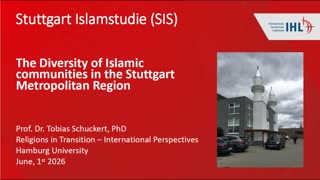
Religious pluralization and internationalization are having a lasting impact on German society. The Stuttgart Islam Study by the Liebenzell Institute for Missiological, Religious, Intercultural, and Social Studies (LIMRIS) provides the first comprehensive empirical survey of the inner Stuttgart metropolitan region (2.7 million inhabitants). The study is based on survey conducted through visits to more than 60 Islamic communities as well as several qualitative interviews. The study explores phenomena that have received little attention to date: the overall landscape of Islamic communities, their denominational diversity, and key areas of activity within Muslim communities in the region around the capital of Baden-Württemberg.
Dr. phil. Tobias Schuckert, PhD is professor of intercultural theology and religious studies at the International University of Applied Sciences Liebenzell. He holds a Ph.D. from Fuller Theological Seminary in Pasadena, California, and a Dr. phil. from Bergische University in Wuppertal, Germany. His research interests include the sociology of lived religion and theories of religious conversion. --- Religion, for many individuals, is practiced not in the abstract, but in concrete, embodied ways—through participation in local religious groups. These groups, often referred to as congregations, are central sites where religious belief, belonging, and behavior are lived out. They provide not only spaces for worship, but also platforms for socialization, community-building, charity, and political engagement.
Local religious groups are remarkably diverse. They vary in size, resources, denominational affiliation, organizational form, leadership structure, activities, and their relationship with their surrounding context. They include parish-based Christian congregations, free churches, mosques, synagogues, temples, and spiritual centers. They can be embedded in religiously diverse urban metropolises or operate in rural, mono-religious settings.
Despite this diversity, and despite their centrality in the religious field, our systematic knowledge of congregations remains limited—especially in the European context. The lecture series presents current congregational studies from various contexts such as Italy, Denmark, Germany, Switzerland, Croatia, and the USA.
The lecture series is organized by the Academy of World Religions at the University of Hamburg with support from the Udo Keller Foundation Forum Humanum.