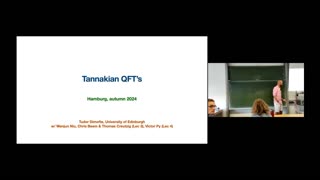
Tannakian QFT's 3 - Tudor Dimofte - Universität Hamburg
- Lecture2Go
- Videokatalog
- F.6 - Mathematik, Informatik, Naturwissenschaften
- MIN-Fakultät
- SFB 1624 : Lectures on Tannakian QFT's
Videokatalog
593 Aufrufe
25.10.2024
Tannakian QFT's 3
Lecture 3: Kazhdan-Lusztig correspondences
In this lecture I’ll ask: what if a topological QFT admits both a Tannakian structure (topological boundaries or interfaces, as in Lecture 1) and holomorphic boundary conditions? The latter represent line operators as modules for a vertex operator algebra. I'll explain how interaction with the former leads to generalized Kazhdan-Lusztig correspondences, relating VOA's and their free-field realizations to quantum groups. (This is related to recent work of Creutzig-Lentner-Rupert, older work of Semikhatov-Tipunin, and ongoing work Gaitsgory.)
---
Quantum field theories often contain rich collections of extended operators, or "defects," intimately connected to symmetries and their dynamics. Given some degree of topological invariance, extended operators are expected to organize themselves into mathematical categories, with various additional structures, such as tensor products coming from collisions of operators. However, it can be quite difficult physically to fully identify/compute these categories — encoding the complete set of extended operators and their correlation functions. In this series of lectures, I’ll discuss systematic approaches to tackling this problem, fundamentally inspired by representation theory (of categories) in mathematics, and the ideas of Tannaka and Koszul duality. I’ll present some recent/ongoing work of mine (joint with Wenjun Niu, and parts with Victor Py, Thomas Creutzig, and Chris Beem), noting also that Tannaka/Koszul duality have a long and rich history in physics, spanning several decades.
---
Quantum field theories often contain rich collections of extended operators, or "defects," intimately connected to symmetries and their dynamics. Given some degree of topological invariance, extended operators are expected to organize themselves into mathematical categories, with various additional structures, such as tensor products coming from collisions of operators. However, it can be quite difficult physically to fully identify/compute these categories — encoding the complete set of extended operators and their correlation functions. In this series of lectures, I’ll discuss systematic approaches to tackling this problem, fundamentally inspired by representation theory (of categories) in mathematics, and the ideas of Tannaka and Koszul duality. I’ll present some recent/ongoing work of mine (joint with Wenjun Niu, and parts with Victor Py, Thomas Creutzig, and Chris Beem), noting also that Tannaka/Koszul duality have a long and rich history in physics, spanning several decades.
Technischer Support
Bitte klicken Sie auf den nachfolgenden Link und füllen Sie daraufhin die notwendigen Felder aus, um unser Support-Team zu kontaktieren!
Link zu der RRZ-Support-Seite